|
Broker Strategy
Some growth strategies don’t age well in due diligence.
Picture two independent insurance brokerages. Both generate $3 million in revenue. Both are owned by principals nearing retirement and planning a sale. But one is likely to attract a much bigger cheque than the other.
It doesn’t take an M&A expert to know that stronger profitability generally commands a higher price.
“You’re going to get a very different valuation because of profitability,” says Alex Wong, Advisory Partner and Insurance Practice Group Leader at Smythe.
That’s the easy part. The more interesting question is what buyers look at once profitability is no longer the obvious differentiator.
What’s driving growth? How dependent is the business on key individuals? Does it offer something a buyer would struggle to replicate? How much of its earnings can a buyer reasonably expect to sustain after the deal closes?
Those questions explain why two brokerages with similar financials can command very different valuations.
When profits match
If two brokerages are equally profitable on paper, buyers start looking for evidence of organic growth. That’s become more important, and more difficult to judge, in a softer commercial market.
“There’s been a big change in the last couple of years as commercial insurance has moved into a much softer market,” says Wong. “For a long time, when the market was hard, every brokerage was showing growth. As long as they were retaining clients, they could grow from a revenue standpoint.
“That’s not the case anymore. Among buyers, there’s now a lot more focus on whether brokerages are actually increasing client counts and policies in force (PIF). It’s not just about top-line revenue anymore.”
If revenue holds steady or grows while policy counts shrink, buyers may wonder whether the brokerage is growing its book or simply benefiting from higher premiums.
Owner dependency is another major consideration. A buyer can replace brokerage management more easily than client relationships built over decades. If those relationships rest with the owner or a handful of senior brokers, clients may follow them out the door after a sale.
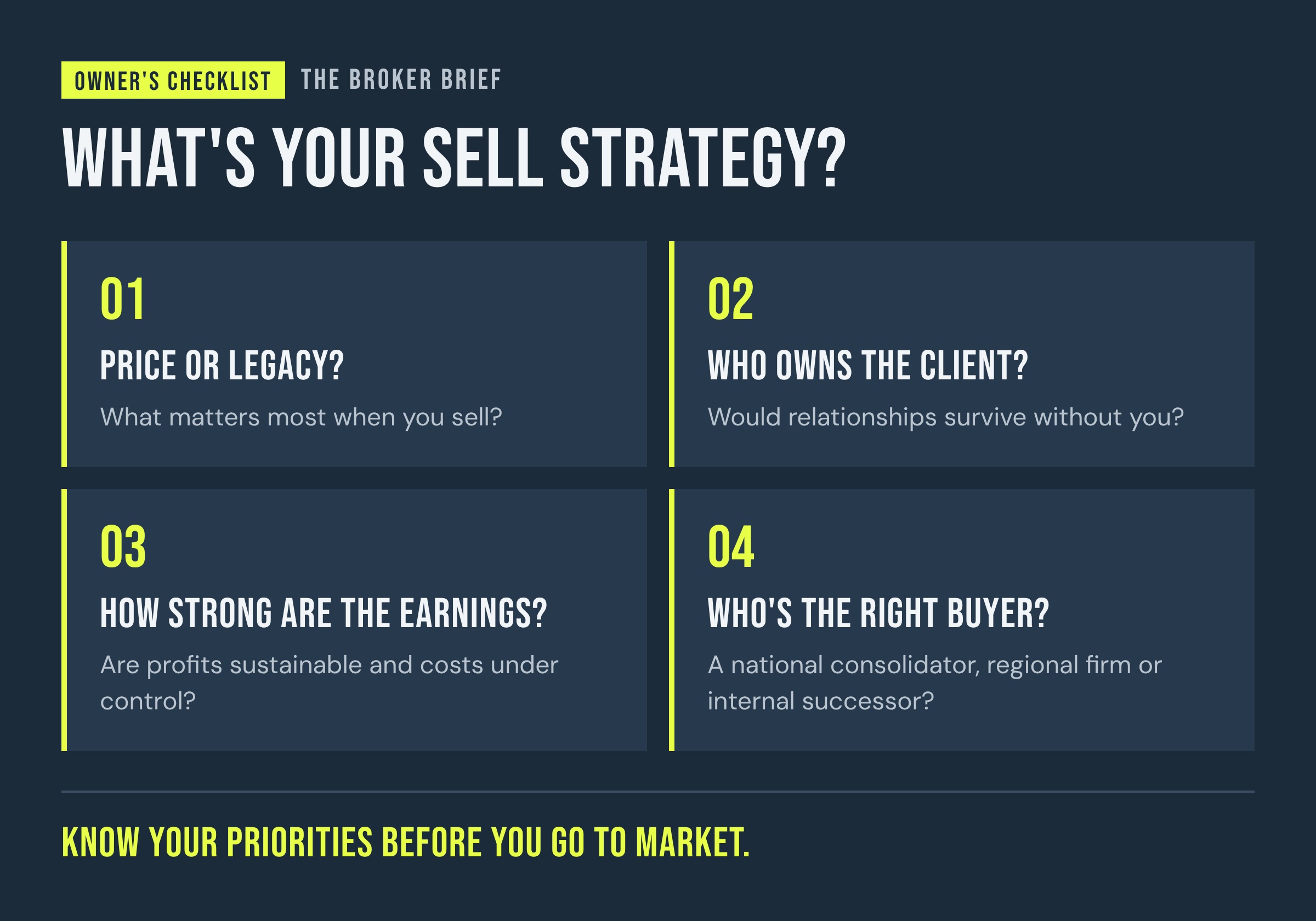 Wong’s advice for owners planning to sell in the next few years is blunt: “Hands down, the main thing you want to focus on is reducing that owner dependency.”
A simple test: if you stepped away tomorrow, would your clients know who else to call?
The mix of business matters, too. Buyers continue to favour commercial books, particularly those with specialized expertise. A brokerage that offers something distinctive, whether that’s a niche, technical expertise, strong talent or access to a particular client segment, may command a premium because it’s difficult to replicate.
Go big or go niche
Large consolidators such as BrokerLink, Westland Insurance Group and AXIS Insurance Managers continue to drive much of the brokerage M&A market. According to MarshBerry’s Canadian Quarterly Insurance Brokerage Market Update, the five most active buyers accounted for 88.2% of announced transactions in Q1 2026.
But the acquisition market looks different than it did a few years ago. During the deal boom of 2020-2022, buyers showed strong appetite for brokerages of almost every size and type. Today, many of the largest acquirers are more selective, prioritizing larger transactions or brokerages that bring something distinctive to the table.
“Over the last couple of years, we’ve seen a drop-off in demand for smaller, single-location retail brokerages, whether focused on personal or commercial lines,” says Wong. “Those businesses have seen a decline in both buyer demand and valuations.”
The economics help explain the shift. “For a billion-dollar brokerage, a smaller acquisition doesn’t move the needle,” he says. “The reward for pursuing those deals isn’t necessarily there anymore, unless there’s something special about the brokerage.”
That doesn’t mean smaller brokerages can’t command a strong valuation. A specialized commercial book, niche product, or technical expertise that fits a buyer’s expansion plans can make a small business attractive. So can a team of talented mid-career brokers who are willing to stay on after the sale.
National consolidators aren’t the only potential buyers. Regional and local brokerages continue to make acquisitions, Wong says. They generally can’t match the prices the biggest consolidators pay, but valuations remain higher than they were 10 years ago.
For all the scrutiny buyers apply to profitability, growth, and owner dependency, Wong says brokerage owners looking to sell remain in a strong position. Valuations remain high, and they still have plenty of options. The bigger question isn’t whether a business will attract interest, but which buyer best fits the owner’s team, customers, and retirement goals.
The number buyers really care about
Historically, valuations were often calculated as a multiple of recurring commission revenue. Today, sustainable EBITDA (earnings before interest, taxes, depreciation, and amortization) has become a primary benchmark.
“A lot of owners are focused on premium and commission revenue — it’s all about the top line,” says Wong. “Ultimately, what buyers really care about is how much money they’re going to make. What’s the bottom line? What’s the income?”
For many brokerages, EBITDA and pre-tax earnings end up looking fairly similar because the business typically carries little debt and requires relatively few capital assets, Wong explains. The important question is how much of that earnings performance a buyer can reasonably expect to continue.
For firms with strong profitability and consistent organic growth, EBITDA-based valuations can translate into implied revenue multiples of 6–8x or more in the best cases, according to Smythe’s latest P&C Insurance Brokerage Report.
“The value isn’t really in the historical results,” Wong says. “It’s in what a buyer expects the brokerage to sustain going forward, from a profitability standpoint.”
A strong year can attract attention. Buyers care more about whether the business can repeat it. That’s why recurring earnings, consistent reporting, and sustainable margins matter long before a brokerage goes to market.
Testing the earnings
Profit margin is often the starting point. Wong says many industry valuation benchmarks assume brokerages operate at around 30%. The next question is whether that margin can hold up under scrutiny.
Many fall short of that benchmark. Smythe found the top 20% of brokerages averaged a 42% operating margin, compared with 22% for the rest. The industry average peaked at 32% in 2021, when suppressed claims and elevated contingent profit commissions (CPCs) lifted results, before falling to 28% in 2025.
The source of those earnings matters, too. CPCs accounted for 7% of brokerage revenue in 2025, according to Smythe, but their contribution can vary significantly from year to year.
“If a brokerage has relatively consistent CPCs every year, that can be a good sign,” says Wong. “If the CPCs bounce all over the map […] that makes it harder for a buyer to understand what to expect going forward.”
Personnel costs are another major factor. They accounted for 53% of revenue in 2025, according to Smythe. Among the top 20% of brokerages, the figure was 42%, compared with 58% for the rest. That’s one reason top-performing brokerages can maintain stronger margins.
Some brokerages keep compensation costs tightly controlled, while others offer higher commission splits and signing bonuses to attract top talent, betting that the investment will drive future growth. Wong says he has seen brokerages with commission rates as high as 70%. At that level, a 30% overall profit margin is out of reach — “the math just doesn’t work,” he says.
High commission structures can also raise questions about who owns the client relationships. If brokers have a claim, ownership, or equity in their books, a buyer needs to understand whether those clients will stay with the brokerage after the sale.
Client concentration presents a similar risk. If 20% of revenue comes from three or four clients, losing one could take a significant slice of the acquired earnings with it.
So who gets the bigger cheque?
The foundations of a strong valuation are laid long before a buyer arrives at the table.
An owner who is 10 years from selling is probably still focused on growth, Wong says. “As you get closer and closer to looking to sell, you really want to start focusing on the financial performance of the brokerage.”
Two brokerages can produce the same revenue and still command very different valuations. In the end, the bigger cheque usually goes to the business that gives buyers the most confidence in what they’re buying and the fewest reasons to worry about what happens next.
|
|
|
Three stories worth your attention this week
Markel Canada rolls out contractors and trades offering for brokers
Centerra Gold’s April Savchuk wins Canada’s top risk management honour
Aon: Canada’s P&C market has “favourable” winds heading into 2027
|
MGA Q&A
The Contractor Risk Brokers Are Missing.
Q1What's one class of business brokers are routinely missing — and what should they be doing differently?
Commercial vehicles used by service contractors are an often-overlooked opportunity. Electricians, plumbers, HVAC technicians, and other tradespeople rely on their vehicles every day. Yet these risks can be overlooked when brokers focus on a contractor's general liability coverage without fully reviewing how their vehicles are used. The opportunity is to look beyond traditional commercial fleets and identify smaller businesses operating one or two service vehicles. Brokers should systematically ask their contractor clients about vehicle usage, drivers, business activities, and the equipment they transport. A simple review of their existing commercial accounts can uncover opportunities to provide more complete protection while strengthening the overall client relationship.
Q2What's one thing most brokers get wrong when approaching your market — and how should they be framing it instead?
One common misconception is that a non-standard risk is automatically a bad risk. A new business, a previous cancellation, or an unusual activity can make a client difficult to place in the standard market. But these factors don't necessarily tell the whole story. As a specialty MGA, we encourage brokers to explain why a risk falls outside standard underwriting guidelines rather than simply presenting it as difficult to insure. For example, a contractor with a newly established company may have ten years of industry experience. A business with previous claims may have introduced meaningful risk-management improvements. The right question isn't only: “Why was this risk declined?” It's also: “What makes this risk insurable today?” That shift in perspective can open the door to more constructive underwriting conversations.
Q3If a broker wants to grow their book in your space, what does year one actually look like — where do they start, who do they call, what do they build?
Start with a focused specialty, not a broad list of industries. For brokers looking to develop a specialty commercial portfolio, we recommend choosing one or two segments they understand or where they already have relationships. Construction contractors, small commercial property owners, and businesses with specialized commercial auto needs can provide interesting starting points. During the first three months, review your existing client portfolio, identify potential cross-selling opportunities, and develop a clear understanding of available insurance solutions. Over the following six months, strengthen relationships with specialty underwriting partners, build referral networks, and become familiar with the information required for quality submissions. By the end of year one, the objective should be to have a repeatable approach: a defined target market, strong underwriting relationships, an efficient submission process, and a proactive renewal strategy. Sustainable growth comes from developing expertise and becoming a trusted adviser within a specific niche.
|

|
|
|

|
|
|
|
EDITORIAL. The Broker Brief is editorial content for information only and does not constitute professional, legal or financial advice. No sponsor influence on editorial.
|