|
Broker Strategy
As more insurers explore direct sales, Intact and Definity executives explain where brokers still have the advantage.
By Bethan Moorcraft
Consumers are increasingly turning to search engines and AI tools to research insurance. For independent brokers, that creates a new competitive challenge: how do you make sure prospective customers find you rather than a direct insurer?
The issue came into focus during an executive panel at the IBAO conference in Toronto last week, where leaders from the nation's top carriers discussed changing consumer habits and the future of the broker channel.
Evan Johnson, president and CEO of The Wawanesa Mutual Insurance Company, faced questions about the insurer’s plans to explore direct-to-consumer distribution, announced in March 2026. The move marked a notable development for a company that has historically championed broker-first, broker-only distribution.
“I know that [announcement] didn’t sit well with a lot of people,” said Johnson. “But I haven’t heard a compelling argument yet that is non-emotional as to why we wouldn’t [explore a direct-to-consumer offering] from a business perspective. In the same way, all of you invest in innovation in your own businesses.”
Johnson sat alongside four top executives, including Peter Janzen, president of Intact Insurance, and Paul Macdonald, executive vice-president, personal insurance, Definity Insurance. Notably, every other leader on stage represented an insurer that already offers some form of direct distribution. For Johnson, that reality is difficult to ignore.
“We’re not building a direct-to-consumer to compete with you. It’s to compete with them,” he said of the executives he shared the stage with. He went on to reaffirm Wawanesa’s commitment to brokers: “I 100% believe the right way to buy insurance is through an independent broker, full stop.”
Then came the caveat.
“But at some point in the future, when we look at the trends, it’s very possible that more personal lines and maybe some small commercial will be sold direct,” he said. “Not to invest in that now, frankly, is negligent, in my view, as a custodian of this business for a small period of time.”
A slow drip, not a flood
According to Intact’s Janzen, the shift from intermediated to direct insurance buying remains gradual. He described it as a “drip going from one channel to the other” at a couple of basis points a year.
EY Canada estimates independent brokers still account for more than 70% of P&C premium volume, with a particularly strong presence in personal and small commercial lines. Even if Janzen’s “drip” continues, it will take a long time to erode that lead.
Janzen argued that Canadians who buy direct want convenience, value, and a seamless buying experience. They have no particular problem with brokers.
“That’s what’s great about the broker channel and why it’ll never go away. You’re extremely well positioned to add value, find value for money, and give advice in that consultative space.” Peter Janzen, Intact Insurance “We are committed to the broker channel, and we think it’s going to be there for the long run,” he added. “I think it’ll just be a bit of an evolution as [people change] the way they are shopping and the tools they use to do it.”
If direct-to-consumer competition is growing, what can brokerages do to stay visible and relevant? Comments from the IBAO panel point to three advantages brokers already possess.
Advantage #1: Consumers still want human advice
Canadians are increasingly researching insurance products online, but when they’re ready to buy, “they want to talk to a human,” according to Macdonald.
In a 2025 survey commissioned by Allstate Canada, 49% of respondents said they would contact their broker or agent with an insurance question, compared with 44% who would call their insurer’s customer service department and 35% who would visit its website.
The risk for brokers lies in the handoff. A consumer who has spent an evening comparing coverage online may be ready to buy. If the next step is a web form and a callback in two days, a direct insurer offering an instant quote may win the sale.
Brokerages can hold on to that consumer by making a licensed broker easy to reach at the moment of decision, for example, through a same-day callback or live chat.
Advantage #2: Brokers have the answers consumers are looking for
“The way we differentiate direct and intermediated is not something customers think through,” said Macdonald. Instead, they are looking for answers to their questions and trying to understand their options.
“If brokers have the same online presence and capabilities [as direct], what then would customers choose?” Paul Macdonald, Definity Insurance Getting there means answering the questions consumers are already asking online. For example, a brokerage serving landlords could publish a guide to insuring a rental property, covering questions about basement apartments, liability, and how renting out a property can affect existing home insurance. The page should answer common questions directly, explain where coverage depends on the circumstances, and flag when a broker’s advice is needed.
The same approach can work across other specialisms, from contractors to restaurant owners. The aim is to give prospective clients useful answers while showing them where a broker’s expertise matters.
Advantage #3: Brokers have a head start online
Brokers may be better positioned than they realize. Large language models (LLMs) and AI-powered search tools increasingly surface educational content, reviews, expert commentary, and informational resources.
“If you look at some LLM rankings, broker names rank very high,” Macdonald said. “Why? Because of all that content that’s already there.”
Brokerages don’t need the advertising budgets of large direct writers to compete here. They can draw on their specialist knowledge and customer relationships to give prospective clients useful information and make themselves easier to find online.
Keeping Google Business Profiles up to date, collecting customer reviews, and creating dedicated website pages for specific locations or specialisms can help brokerages reach people searching for insurance. A generic commercial insurance page is unlikely to demonstrate the same depth of expertise as a page explaining the coverage considerations facing a restaurant owner or property investor.
“Have more of your experts, your brokers, produce content, video content, advice, referral content, and also [get] customer feedback. All of that stuff gets highly ranked in LLMs,” said Macdonald. “It’s more about content now than ever. You need to get your brand out there. You need to be visible.”
There are even new acronyms for this emerging discipline: answer engine optimization (AEO) and generative engine optimization (GEO). Underneath the alphabet soup, the idea is simple: make your expertise easier for search engines and AI tools to find and draw on when answering a consumer’s question.
No guaranteed formula exists for appearing in ChatGPT or other AI-generated answers. But it helps to publish useful, specific content, name the experts behind it, and link to credible sources.
Showing up where customers are looking
Johnson’s comments at the IBAO panel highlighted the dilemma facing brokers: an insurer can believe in the value of independent brokers and still decide it needs a direct option.
Brokers can’t control how insurers distribute their products, but they can work to ensure customers find them when they start looking for insurance.
What are you doing to make your brokerage stand out when consumers search for insurance online?
Let us know in the comments. At The Broker Brief, we welcome candid discussion about the challenges and opportunities facing the industry.
|
|
|
Three stories worth your attention this week
| Revealed: 2026 IBAO Awards of Excellence Winners |
| Fires, floods and storms: $3.7 billion in insured damage makes summer 2026 third worst on record |
| Aviva reaches $150M settlement in COVID BI coverage fight |
|
|
|
Data Snapshot
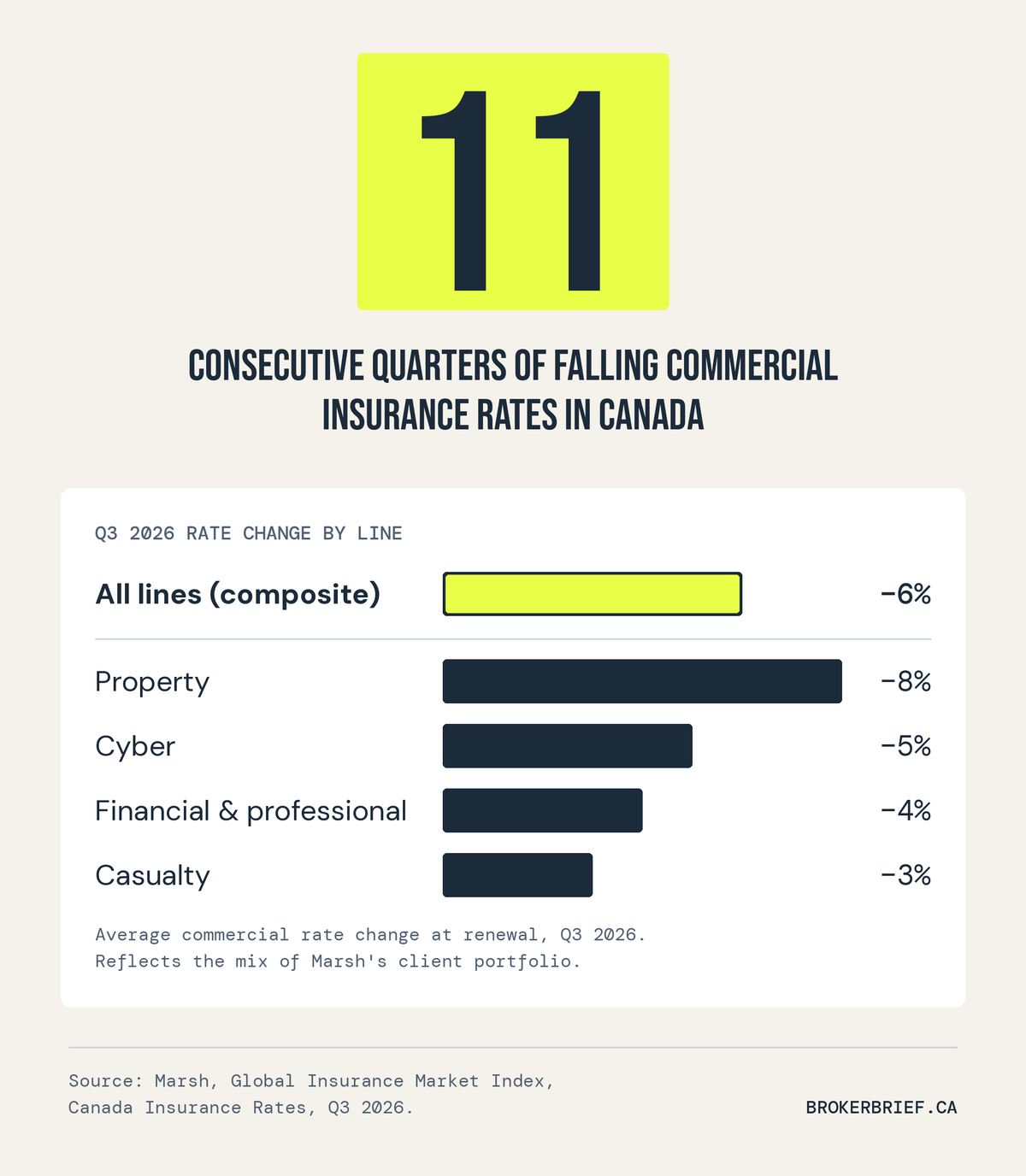
Commercial insurance rates in Canada fell 6% in the third quarter, marking the 11th consecutive quarter of declines, according to Marsh's Global Insurance Market Index. Property led the way with an 8% decrease, as strong insurer results, lower reinsurance costs and increased competition expanded market capacity. Financial and professional lines fell 4%, while cyber rates declined 5%.
Casualty rates dropped 3%, the 13th consecutive quarterly decrease, though underwriting on wildfire exposure and PFAS became increasingly detailed. Underwriters continued to offer policy concessions to win business. Despite falling cyber rates, claims severity kept rising, with ransomware and privacy events remaining particularly costly.
Brokers with well-prepared submissions remain best positioned to secure favourable pricing, while accounts with losses or poor-quality data may see fewer benefits.
|
|
|
|
|
|
EDITORIAL. The Broker Brief is editorial content for information only and does not constitute professional, legal or financial advice. No sponsor influence on editorial.
|